




When a routine ultrasound at 20 weeks of pregnancy revealed that a young mother’s unborn baby had its intestines developing outside its body, doctors in Barcelona faced one of the most complex decisions in modern medicine. What happened next, a world-class surgical team operating on a fetus weighing just 700 grams, inside the womb, at 28 weeks of gestation, has placed Barcelona at the very forefront of fetal surgery in Europe, and reaffirmed the city’s reputation as a global reference for high-complexity medical care. This article explains what gastroschisis is, what made this intervention so extraordinary, and why patients from around the world are increasingly choosing Barcelona for the most critical moments in their lives.
What Is Gastroschisis? Understanding a Rare and Serious Congenital Condition
Gastroschisis is a congenital malformation, present from birth, in which the abdominal wall fails to close properly. The result: the intestines, and sometimes other organs, develop outside the body. The opening typically forms to the right of the umbilical cord. It is not linked to any genetic defect, though its exact cause is still being studied.
The condition is uncommon, appearing in roughly three to four cases per every 10,000 births. In Spain, approximately 120 new cases are diagnosed each year.
Simple vs. Complex Gastroschisis: Why Severity Matters
Not all cases are equal. Most (around 80%) are classified as “simple” gastroschisis, where a portion of the bowel is outside the abdomen but remains relatively healthy. These cases are typically managed after birth through surgical repair.
The remaining 20%, however, are classified as complex gastroschisis, the most severe form. In these cases, the intestines may show signs of compression, inflammation, reduced blood supply, or even early tissue damage (a process doctors call intestinal necrosis). The risks for the baby in these situations are considerably higher: the possibility of short bowel syndrome, long-term dependence on intravenous nutrition, or, in the worst cases, the need for a bowel transplant.
It was precisely this most severe form that the team in Barcelona had to face.
Europe’s First: The Historic Operation at SJD Barcelona Children’s Hospital and Hospital Clínic
In February 2026, a multidisciplinary team from BCNatal, the clinical consortium for maternal-fetal medicine and neonatology that brings together SJD Barcelona Children’s Hospital and Hospital Clínic de Barcelona, performed the first fetal surgery for gastroschisis ever carried out in Europe.
The case involved a 20-year-old mother. During a routine 20-week scan, doctors detected the malformation, confirmed between weeks 24 and 25 as complex gastroschisis. Virtually the entire intestinal tract, approximately 80 centimeters, had developed outside the abdominal cavity, and the baby was already showing signs of inflammation and compression. Without intervention, the risk of irreversible damage before birth was real and growing. After careful evaluation and consultation with the hospital’s ethics committee, the team decided to act, not after birth, but while the baby was still in the womb.
Europe’s first fetal surgery for complex gastroschisis
In this video, Prof. Eduard Gratacós and the baby’s mother explain how the multidisciplinary team at BCNatal, SJD Barcelona Children’s Hospital and Hospital Clínic de Barcelona carried out Europe’s first fetal surgery for complex gastroschisis.
Inside the Operating Room: Precision at the Limits of Medicine
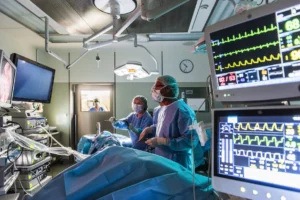
The intervention took place on February 10, 2026, and lasted approximately two and a half hours. Surgeons accessed the uterus through an abdominal incision in the mother. Using fetal laparoscopy techniques, extremely delicate minimally invasive tools adapted for intrauterine use, the team carefully repositioned the fetus and gradually returned the intestines to the abdominal cavity through an opening of just 1.5 centimeters.
The numbers alone convey the extraordinary nature of the challenge: a 700-gram fetus, 80 centimeters of bowel, and a gap barely larger than a fingertip. Every movement had to be calculated with millimetric precision. The operation was led by specialists in fetal medicine, pediatric surgery, and anesthesiology. “What we propose in cases like this is fetal therapy that until now had not been carried out, partly due to its complexity,” explained Eduard Gratacós, director of BCNatal.
A Successful Outcome
Following the surgery, regular ultrasound monitoring confirmed a reduction in intestinal inflammation and a gradual return to normal bowel appearance. The pregnancy continued for another six weeks, until week 34, when the baby was born by caesarean section.
Despite a low birth weight, the clinical progress was positive. The baby was discharged after a short hospital stay and is currently feeding normally, a result that specialists describe as highly encouraging for the future of this technique in Europe.
Prior to this intervention, this type of fetal surgery for gastroschisis had only been performed on a small number of occasions, and exclusively in the United States and Colombia.
Why Barcelona? The City That Has Made Fetal Medicine a World Reference
This landmark procedure did not happen by accident. Barcelona has spent decades building the infrastructure, talent, and institutional culture required to push the boundaries of medicine, particularly in fields as demanding as fetal surgery.
BCNatal: One of Europe’s Largest Maternal-Fetal Medicine Centers
BCNatal, the joint program of SJD Barcelona Children’s Hospital and Hospital Clínic, is among the most comprehensive maternal-fetal medicine centers in the world. Each year the program sees over 7,000 births and attends thousands of referred complex cases from across Spain and abroad. It has accumulated experience in more than 2,000 fetal surgeries and has been the first in the world to carry out several intrauterine interventions.
The team at SJD Barcelona Children’s Hospital, one of the largest pediatric hospitals in Europe, treats more than 100 complex fetal cases annually and has pioneered techniques ranging from fetal cardiac interventions to surgical repair of diaphragmatic hernia. The institution’s Emergency Department alone handles over 120,000 pediatric patients per year.
Multidisciplinarity: The Key to High-Complexity Success
What makes Barcelona’s approach distinctive is not just technical skill, but the way expertise is organized. Cases like the gastroschisis surgery require the simultaneous involvement of specialists who, in other settings, might rarely collaborate: fetal medicine physicians, pediatric surgeons, neonatologists, anesthesiologists, neonatal intensive care specialists, and clinical ethicists.
This model of integrated multidisciplinary care is not unique to SJD. It defines the clinical culture of the hospitals that form the Barcelona International Hospitals (BIH) network, a collective of leading institutions that together represent the full spectrum of advanced medicine in the city.
What This Breakthrough Means for the Future of Prenatal Care
The successful completion of Europe’s first fetal surgery for gastroschisis is more than a remarkable case story. It signals a meaningful shift in what is possible within prenatal medicine, and raises important questions about how congenital malformations will be managed in the years ahead.
Fetal Surgery Is Expanding Its Scope
Until recently, intrauterine surgery was largely limited to conditions such as twin-to-twin transfusion syndrome, diaphragmatic hernia, or certain cardiac malformations. The gastroschisis intervention demonstrates that it may be possible to address a broader range of structural defects before birth, potentially preventing organ damage that would otherwise be irreversible.
Earlier Intervention, Better Outcomes
The core principle behind this surgery is prevention. By correcting the defect before birth, the team avoided prolonged intestinal inflammation and mechanical damage in the amniotic fluid. Complications that would have been far harder to treat after delivery were addressed before they could fully develop.
Ethical Rigor as Part of the Process
It is worth noting that the decision to operate was not taken unilaterally. The team at SJD and Clínic consulted the hospital’s ethics committee before proceeding, a process that reflects the careful, patient-centered approach that characterizes high-complexity medicine in Barcelona.
Frequently Asked Questions About Gastroschisis and Fetal Surgery in Barcelona
What is gastroschisis and how is it diagnosed?
Is it possible to treat gastroschisis before birth?
What are the risks of complex gastroschisis for the baby?
What hospitals in Barcelona specialize in fetal medicine and complex pregnancy care?
Can international patients access fetal surgery or high-risk pregnancy care in Barcelona?
How does Barcelona compare to other European cities for medical tourism and advanced medical care?
Barcelona as a Global Reference for Complex Medical Care
The story of Europe’s first fetal surgery for gastroschisis is, at its heart, a story about what becomes possible when exceptional talent, institutional courage, and collaborative medicine come together. A 700-gram fetus, a 20-year-old mother, and a team willing to attempt what had never been done before on this continent, and succeeding.
For international patients facing complex medical journeys, Barcelona offers something genuinely rare. The city brings together world-class hospitals, a culture of multidisciplinary innovation, and a network of institutions covering everything from pediatrics to rehabilitation, from urology to women’s health. Together, they are capable of responding to nearly any clinical challenge.
The Barcelona International Hospitals network exists precisely to help patients find their way to the right expertise, at the right moment.
Looking for advanced medical care in Barcelona?
Whether you are seeking specialist opinion, planning a complex procedure, or navigating a diagnosis that requires world-class expertise, the team at Barcelona International Hospitals is here to help.
Contact Barcelona International Hospitals →
This article references the clinical case reported by SJD Barcelona Children’s Hospital and Hospital Clínic. For the full original report, visit the official SJD news release.