
Spinal stenosis can gradually make walking, standing and everyday activities increasingly difficult. Some people experience pain, numbness or weakness in the legs, while others can walk only short distances before needing to stop or sit down.
However, finding spinal narrowing on an MRI does not automatically mean that an operation is necessary. Many people can initially be managed with physiotherapy, medication, exercise or other non-surgical treatments. Spinal stenosis surgery is generally considered when symptoms remain significant, neurological function is threatened or mobility and quality of life continue to deteriorate despite appropriate conservative care.
This is why specialist assessment matters. Within the Barcelona International Hospitals network, patients can access hospitals where spine surgeons, neurosurgeons, rehabilitation specialists, radiologists and other professionals can evaluate the condition together and determine whether surgery is genuinely the best option.
What is spinal stenosis?
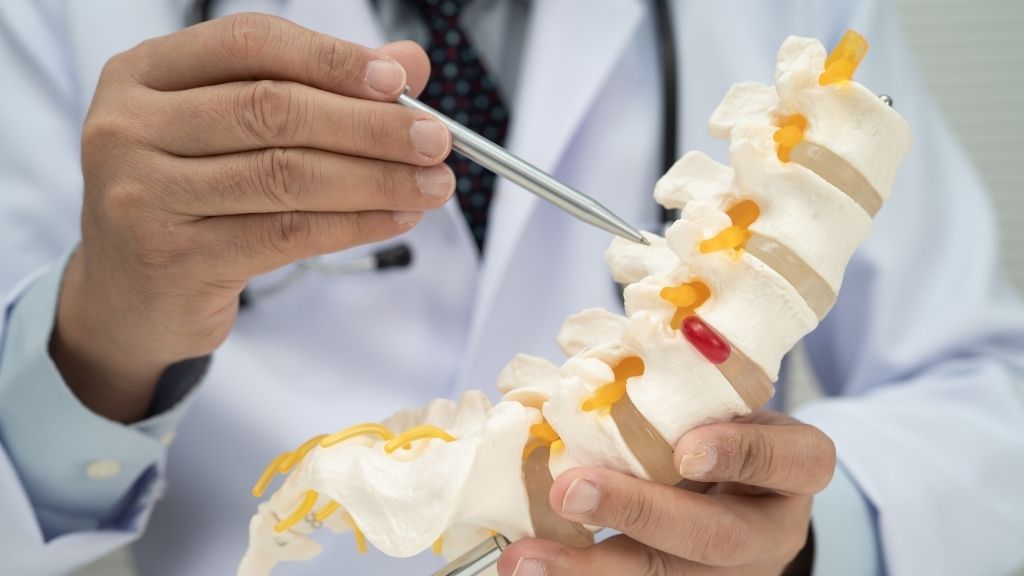
Spinal stenosis is a narrowing of the spaces within the spine. When this narrowing compresses nerves or, in the cervical spine, the spinal cord, it can cause pain, numbness, weakness, difficulty walking and other neurological symptoms.
What causes spinal stenosis?
Spinal stenosis most commonly develops as part of age-related degenerative changes in the spine. Over time, discs may lose height, joints can enlarge and ligaments may thicken. Together, these changes can reduce the space available for the nerves.
Other conditions can contribute, including:
- Degenerative disc disease.
- Osteoarthritis of the spinal joints.
- Herniated or bulging discs.
- Spondylolisthesis, where one vertebra moves relative to another.
- Previous spinal surgery.
- Spinal fractures or deformities.
- Congenital narrowing of the spinal canal.
- Less commonly, tumours or other lesions affecting the spinal canal.
The lumbar spine is frequently affected, although stenosis can also occur in the cervical region of the neck.
What are the symptoms of lumbar spinal stenosis?
Lumbar spinal stenosis commonly affects the nerves supplying the legs. One characteristic symptom is neurogenic claudication: pain, heaviness, tingling or weakness that appears when walking or standing and improves when sitting or leaning forward.
Patients may also experience:
Leg pain
Pain may radiate from the lower back or buttock into one or both legs.
Numbness or tingling
Compression of spinal nerves can alter sensation in the legs or feet.
Reduced walking distance
Patients may find themselves stopping increasingly often because of pain or weakness.
Muscle weakness
More significant nerve compression can affect strength and functional movement.
Importantly, the severity of an MRI finding does not always correspond to the severity of symptoms. Some people have significant narrowing on imaging but relatively few clinical problems.
Why an MRI alone cannot decide whether you need surgery
This is one of the most important aspects of spinal stenosis treatment.
A scan provides essential anatomical information, but treatment should not be based on imaging alone. Specialists must determine whether the narrowing seen on the scan actually explains the patient’s symptoms.
For example, difficulty walking can also be caused by hip disease, vascular problems, peripheral neuropathy or other neurological conditions. Back pain itself can have several simultaneous causes.
A comprehensive evaluation may therefore involve neurological examination, assessment of walking and balance, X-rays, MRI or CT imaging and, in selected cases, neurophysiological studies or additional diagnostic tests.
The key question is not simply “Is there stenosis?”
The more useful question is whether the stenosis is responsible for symptoms severe enough to justify surgery and whether an operation is likely to address the specific functional problem affecting the patient.
Can spinal stenosis be treated without surgery?
Yes. Many patients begin with conservative management, particularly when there is no progressive neurological deficit.
Treatment may include:
- Individualised physiotherapy.
- Exercises to improve strength, mobility and spinal control.
- Medication for pain or inflammation when appropriate.
- Modification of activities that exacerbate symptoms.
- Weight management when clinically relevant.
- Image-guided injections in selected patients.
- Management of associated chronic pain.
These treatments do not necessarily reverse the anatomical narrowing, but they may reduce symptoms and help patients maintain function sufficiently to avoid or postpone surgery.
When is spinal stenosis surgery necessary?
The decision is individual. Spinal stenosis surgery becomes more relevant when there is a clear relationship between nerve compression and significant symptoms that have not responded adequately to non-surgical care.
Surgery may be considered when:
- Leg pain or neurogenic claudication substantially limits walking.
- Symptoms continue despite an appropriate period of conservative treatment.
- Muscle weakness or another neurological deficit is developing or progressing.
- Daily activities and independence are significantly affected.
- Nerve or spinal cord compression creates concern about neurological function.
- The patient’s clinical symptoms correlate clearly with imaging findings.
For many patients with lumbar stenosis, the operation is elective rather than urgent. This provides time to compare conservative and surgical options and to understand the expected benefits and limitations of each approach.
When can spinal stenosis become urgent?
Some situations require more rapid medical assessment.
Sudden or rapidly progressive weakness, major changes in walking, loss of bladder or bowel control or numbness in the area around the buttocks and genitals require urgent evaluation because they can indicate significant nerve compression.
Cervical spinal stenosis can also be particularly important when it compresses the spinal cord and causes cervical myelopathy. Symptoms may include problems with balance, hand coordination, walking or fine motor control.
These neurological signs change the treatment discussion and should be assessed by an experienced spine team.
What does spinal decompression surgery involve?
The fundamental objective of spinal decompression surgery is to create more space for compressed neural structures.
Depending on the location and anatomy of the stenosis, the surgeon may remove part of the bone, ligament or other tissue contributing to compression.
Procedures can include laminectomy, laminotomy or other targeted decompression techniques.
In selected patients, surgeons may perform a smaller or more localised decompression using minimally invasive or microsurgical approaches. The objective should not simply be to make the incision smaller, but to decompress the appropriate nerves while preserving stability whenever possible.
Does spinal stenosis surgery always require spinal fusion?
No.
This distinction is particularly important for patients researching lumbar spinal stenosis surgery.
If the spine is sufficiently stable, decompression alone may be appropriate. However, some patients have instability, significant spondylolisthesis, deformity or other structural problems that may require the surgeon to combine decompression with spinal fusion.
Fusion joins two or more vertebrae to stabilise a section of the spine. Screws, rods and bone grafts may be used to support this process.
Because fusion generally represents a larger intervention than decompression alone, specialists should establish whether stabilisation is actually necessary rather than assuming that every patient with stenosis requires it.
Decompression
Primarily aims to relieve pressure on compressed nerves or the spinal cord.
Decompression + fusion
May be considered when nerve compression is accompanied by instability or another structural problem requiring stabilisation.
Why multidisciplinary spine care matters
Spinal stenosis is a good example of why complex medicine cannot always be reduced to a single surgeon and a scan.
The patient’s symptoms may involve neurological function, musculoskeletal health, chronic pain and reduced physical capacity. Other diseases may also influence whether surgery is appropriate or how it should be performed.
A multidisciplinary pathway may involve:
- Orthopaedic spine surgery for structural and degenerative spinal conditions.
- Neurosurgery for nerve and spinal cord compression.
- Radiology for detailed assessment and surgical planning.
- Physical medicine and rehabilitation for conservative treatment and functional recovery.
- Physiotherapy before and after surgery.
- Pain specialists when symptoms require interventional or complex pain management.
- Anaesthesiology and internal medicine when patients have additional medical conditions affecting surgical risk.
The aim is not to involve as many specialists as possible. It is to bring together the disciplines needed to determine the least invasive treatment capable of addressing the patient’s actual problem.
Spinal stenosis treatment in Barcelona
Barcelona brings together hospitals with expertise across spinal surgery, neurosurgery, orthopaedics, rehabilitation and advanced diagnostic imaging. For international patients, this can be particularly valuable when symptoms are complex or when previous treatments have not produced the expected result.
Hospital Quirónsalud Barcelona
Hospital Quirónsalud Barcelona has a dedicated multidisciplinary Spine Unit treating degenerative spinal disease, spinal stenosis, disc herniation, spondylolisthesis, deformity, fractures and other complex spinal conditions.
Its model integrates orthopaedic spine surgery and neurosurgery with physical medicine and rehabilitation, physiotherapy and other disciplines. Treatment options include both non-surgical management and procedures such as spinal decompression and fusion when clinically indicated.
This combination is especially relevant to spinal stenosis because the decision to operate begins with determining whether surgery is necessary at all.
Hospital Universitari Dexeus
Hospital Universitari Dexeus brings together orthopaedic and neurosurgical expertise within a multidisciplinary university hospital environment.
For patients with degenerative spinal disease, access to diagnostic imaging, surgical specialties, anaesthesia and rehabilitation within the same hospital can facilitate coordinated assessment and treatment planning.
Centro Médico Teknon
Centro Médico Teknon provides specialised surgical and neurological care within a high-complexity hospital setting.
Its multidisciplinary infrastructure can be relevant for international patients seeking assessment of spinal conditions, particularly when the case requires advanced diagnostics or coordination between different medical and surgical specialties.
Why consider a second opinion before spine surgery?
Different spinal conditions can produce similar symptoms, and more than one surgical technique may sometimes be technically possible.
A specialist second opinion can help clarify whether surgery is necessary, whether decompression alone could be sufficient or whether stabilisation should also be considered.
For international patients, reviewing imaging and medical records before travelling can also help determine which hospital and specialist team are most appropriate.
What does spinal stenosis surgery recovery involve?
Spinal stenosis surgery recovery depends considerably on the type of operation.
A limited decompression and a multilevel decompression combined with fusion are very different procedures, so patients should avoid relying on a single generic recovery timeline.
Early recovery generally focuses on pain control, safe mobilisation and preventing postoperative complications. Patients are encouraged to begin moving according to the instructions of their surgical team.
After discharge, rehabilitation may progressively address:
- Walking tolerance.
- Muscular strength.
- Balance and coordination.
- Mobility and functional movement.
- Return to work and everyday activities.
- Long-term physical conditioning.
Improvement in leg symptoms may occur relatively early in some patients, while recovery of strength or longstanding neurological symptoms may take considerably longer.
What are the risks of spinal stenosis surgery?
As with any operation, spine surgery has potential risks. These vary according to the patient’s health, the complexity of the condition and the type of procedure performed.
Possible complications include infection, bleeding, blood clots, cerebrospinal fluid leakage, nerve injury and anaesthetic complications. Fusion procedures can have additional considerations related to instrumentation, bone healing or adjacent levels of the spine.
The presence of a risk does not mean that it will occur. It does mean that the expected benefit of surgery should be weighed carefully against the risks for the individual patient.
Planning spine surgery in Barcelona as an international patient
Patients considering spine surgery in Barcelona can usually begin the evaluation before travelling.
Useful documentation includes:
- A recent MRI or CT scan and the original image files.
- Recent X-rays when available.
- A specialist report explaining the diagnosis.
- A description of symptoms and how long they have been present.
- Information about previous physiotherapy, injections or surgery.
- A current medication list.
- Relevant neurological or medical reports.
A preliminary review can help determine whether further diagnostic testing is required and whether the patient should initially see an orthopaedic spine surgeon, neurosurgeon, rehabilitation specialist or another professional.
This is particularly useful for patients who have already been advised to undergo fusion or complex spinal surgery and want to understand whether alternative approaches should also be considered.
Choosing the right treatment, not simply the most advanced procedure
The most important question in spinal stenosis is not which surgical technology is newest. It is whether the patient’s symptoms truly arise from nerve or spinal cord compression and which treatment can address the problem with an appropriate balance between benefit and risk.
For some patients, the answer will remain rehabilitation and conservative treatment. For others, decompression can restore space around compressed nerves. And when stenosis is accompanied by instability or complex structural disease, a more extensive reconstruction may be necessary.
A multidisciplinary evaluation helps make those distinctions.
Through Hospital Quirónsalud Barcelona, Hospital Universitari Dexeus and Centro Médico Teknon, Barcelona International Hospitals connects international patients with specialised hospitals capable of combining advanced diagnostics, spine surgery and rehabilitation within coordinated treatment pathways.
Request a spinal stenosis assessment in Barcelona
If you have been diagnosed with spinal stenosis or have been advised to undergo spine surgery, Barcelona International Hospitals can help you identify the most appropriate specialist team within its hospital network.
Send your medical report and recent imaging for an individual review before planning your trip.