
Heart rhythm disorders are among the most common cardiovascular conditions worldwide. In many cases, they can be managed effectively with medication or standard procedures. However, some arrhythmias are more complex, harder to locate and more difficult to treat.
For international patients seeking advanced cardiology care, Barcelona offers access to highly specialised electrophysiology teams, innovative diagnostic tools and advanced treatment planning for complex cardiac arrhythmias.
One recent example is the incorporation of ACORYS® at barnaclínic+, the first private centre in Spain and one of the first in Europe to use this non-invasive cardiac mapping technology for complex arrhythmias. This article is based on information published by barnaclínic+ about this innovation and its role in advanced cardiac electrophysiology.
What are cardiac arrhythmias?
Cardiac arrhythmias are disorders of the heart’s electrical system. They occur when the heart beats too fast, too slowly or irregularly. Some arrhythmias are mild, while others may affect quality of life or increase the risk of more serious cardiovascular complications. Common types of arrhythmias include:
- Atrial fibrillation
- Atrial flutter
- Ventricular tachycardia
- Supraventricular tachycardia
- Arrhythmias of uncertain origin
Symptoms can vary depending on the type and severity of the rhythm disorder. Some patients experience palpitations, dizziness, fatigue, shortness of breath or chest discomfort. Others may have no obvious symptoms and discover the arrhythmia during a routine examination or cardiac test. Because arrhythmias can have different causes and patterns, accurate diagnosis is essential before deciding on the most appropriate treatment.
Why complex arrhythmias are difficult to diagnose
In complex arrhythmias, one of the main challenges is identifying exactly where the abnormal electrical activity begins. The heart’s electrical system is highly dynamic. In some patients, the arrhythmia may originate from a very specific area. In others, it may involve several regions or appear intermittently, making it harder to detect during conventional testing.
This is particularly relevant in cases such as complex atrial fibrillation, ventricular tachycardia, atrial flutter or arrhythmias whose origin is not clear.
For these patients, advanced cardiac mapping can help specialists understand the electrical behaviour of the heart in greater detail and plan treatment with greater precision.
What is non-invasive cardiac mapping?
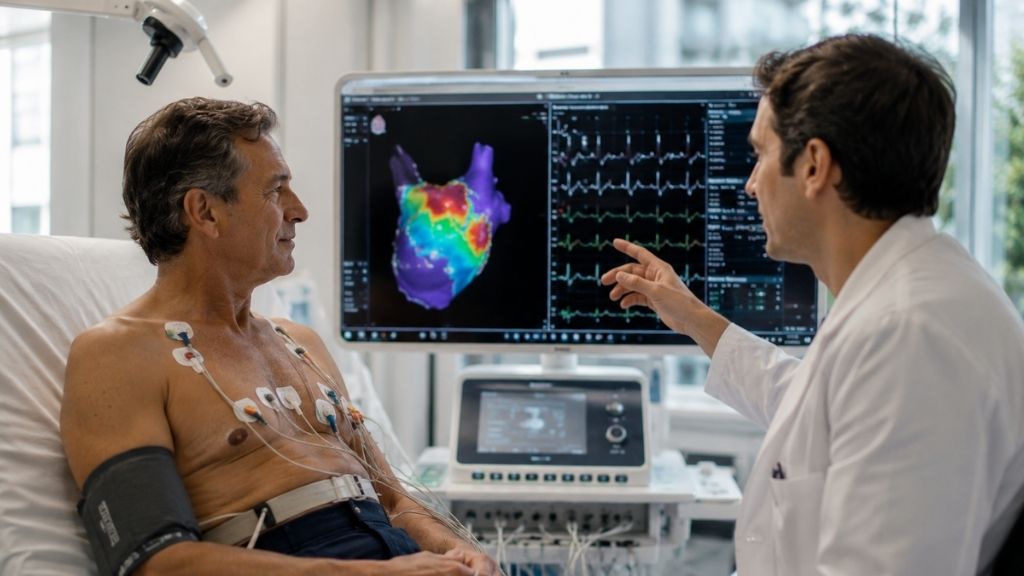
Non-invasive cardiac mapping is an advanced diagnostic technique that studies the electrical activity of the heart without requiring an invasive procedure at the initial mapping stage. Traditional electrophysiology studies often analyse the heart point by point. By contrast, advanced mapping technologies can provide a more global view of the heart’s electrical behaviour.
This broader perspective can help specialists understand how the arrhythmia develops, where it may originate and how best to approach treatment.
At barnaclínic+, the ACORYS® system allows specialists to obtain a global electrical map of the heart in just a few minutes and in a single heartbeat, according to information published by the centre.
ACORYS® at barnaclínic+: a new step in advanced electrophysiology
The Arrhythmia Unit at barnaclínic+, formed by specialists from Hospital Clínic de Barcelona, has incorporated ACORYS®, an advanced non-invasive cardiac mapping technology for complex arrhythmias.
According to barnaclínic+, this makes the centre the first private hospital in Spain and one of the first in Europe to use this technology. ACORYS® was developed by Corify Care, a spin-off of the Polytechnic University of Valencia. The system is based on mathematical modelling and artificial intelligence applied to clinical practice.
Its objective is to support the diagnosis and treatment planning of complex arrhythmias by helping specialists identify the origin of certain rhythm disorders more precisely.
How advanced cardiac mapping helps treatment planning
For many patients with complex arrhythmias, the goal is not only to diagnose the rhythm disorder, but also to define the most effective treatment strategy.
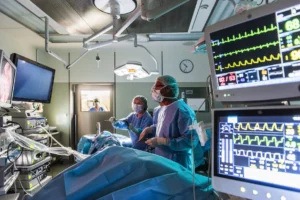
One of the main uses of non-invasive cardiac mapping is to support planning before cardiac ablation. Ablation is a procedure used to treat certain arrhythmias by targeting the areas of heart tissue responsible for the abnormal electrical signals.
By providing additional information before the procedure, advanced mapping may help the electrophysiology team:
| Clinical need | How cardiac mapping can help |
|---|---|
| Locate the origin of the arrhythmia | Provides a global view of the heart’s electrical activity |
| Plan cardiac ablation | Helps define the therapeutic strategy before the procedure |
| Reduce uncertainty | Supports decision-making in complex cases |
| Personalise treatment | Allows a more detailed understanding of each patient’s arrhythmia |
| Complement other diagnostic tests | Can support findings from cardiac MRI and other studies |
This does not mean that every patient with an arrhythmia needs this technology. Its value is especially relevant in more complex cases, where the origin of the rhythm disorder is difficult to identify or where previous treatments have not provided the expected result.
This personalised approach is part of a broader trend in advanced medicine, also explored in our article on Precision Medicine in Spain: How Barcelona Is Leading a New Era of Personalised Cancer Treatment.
Which patients may benefit from advanced arrhythmia evaluation?
Patients may benefit from a specialised electrophysiology evaluation when they have symptoms, recurrent rhythm disorders or complex findings that require advanced study. This may include patients with:
- Recurrent atrial fibrillation
- Ventricular tachycardia
- Atrial flutter
- Palpitations of uncertain origin
- Previous unsuccessful arrhythmia treatment
- Complex cardiac history
- Need for cardiac ablation planning
For international patients, seeking a specialised opinion in Barcelona o second medical opinion can help clarify the diagnosis, review previous tests and determine whether advanced mapping or ablation may be appropriate.
Advanced cardiology across Barcelona International Hospitals
Barcelona International Hospitals brings together leading medical institutions in Barcelona with experience across different areas of highly specialised care.
Within advanced cardiology and electrophysiology, barnaclínic+ and Hospital Clínic de Barcelona play an important role through their expertise in arrhythmia diagnosis, cardiac electrophysiology and ablation techniques.
Other BIH-associated hospitals also contribute to cardiovascular and complex medical care in complementary ways:
- Centro Médico Teknon: advanced diagnostics, cardiovascular care and high-complexity medical services.
- Hospital Quirónsalud Barcelona: multidisciplinary medical and surgical care, including cardiovascular evaluation.
- Hospital Universitari Dexeus: specialised diagnostics and advanced hospital care in Barcelona.
- SJD Barcelona Children’s Hospital: specialised pediatric cardiology and complex pediatric care.
- Fundació Puigvert: high-complexity surgical and medical expertise, particularly in urology, nephrology and transplantation.
- Institut Guttmann: neurorehabilitation and long-term recovery support for patients with complex neurological conditions.
This network allows international patients to access specialised teams, advanced diagnostics and coordinated care depending on their condition and clinical needs.
Frequently Asked Questions About Complex Arrhythmia Treatment in Barcelona
What is a complex arrhythmia?
What is cardiac electrophysiology?
What is non-invasive cardiac mapping?
What is ACORYS®?
When should I seek a second opinion for an arrhythmia?
Contact Barcelona International Hospitals
If you are seeking specialised evaluation for a complex arrhythmia or advanced cardiology care in Barcelona, Barcelona International Hospitals can help connect you with the most appropriate specialists and centres within our network.
This article references information published by barnaclínic+ about the incorporation of ACORYS® for non-invasive cardiac mapping in complex arrhythmias.
Source: Read the original article published by barnaclínic+.