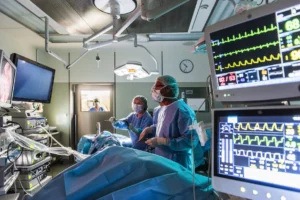


Heart surgery does not always require opening the chest through a full sternotomy. For selected patients, minimally invasive heart surgery in Barcelona may allow surgeons to treat complex cardiac conditions through smaller incisions, sometimes with the assistance of an advanced robotic system.
These approaches can reduce the physical impact of an operation, but they are not suitable for every diagnosis or every patient. The decision depends on the heart condition, previous surgery, anatomy, general health and experience of the cardiovascular team.
This guide explains the difference between robotic, minimally invasive and conventional cardiac surgery, which procedures may be considered and what international patients should know before travelling to Barcelona for treatment.
What is minimally invasive heart surgery?
Minimally invasive cardiac surgery is performed through one or more small incisions between the ribs rather than through a complete opening of the sternum. In selected procedures, robotic instruments may help the surgeon operate inside the chest with enhanced visualisation, precision and freedom of movement.
Robotic heart surgery and minimally invasive surgery: are they the same?
The terms are closely related, but they are not identical. Minimally invasive cardiac surgery describes a broad group of operations performed through smaller surgical access points. Robotic cardiac surgery is one type of minimally invasive approach.
Some minimally invasive procedures are carried out with long conventional instruments through a small incision. Others use video-assisted techniques. In robotic surgery, the surgeon controls articulated instruments from a console while viewing the surgical field through a magnified, high-definition three-dimensional image.
The robotic system does not diagnose the condition, select the procedure or operate independently. Every movement is initiated and controlled in real time by the surgeon.
Conventional open surgery
The surgeon commonly reaches the heart through a sternotomy, in which the breastbone is divided to provide broad access to the chest.
Minimally invasive surgery
The operation is performed through smaller incisions, frequently between the ribs, using specialised instruments and video guidance.
Robotic cardiac surgery
The surgeon uses a console to control highly articulated instruments and a magnified 3D camera through very small access points.
Which heart procedures can be performed robotically?
Robotic surgery is most established in selected operations involving the heart valves and structures inside the heart. The exact indications vary according to the experience of the centre, the surgical objective and the patient’s anatomy.
Robotic mitral valve surgery
The mitral valve controls blood flow between the left atrium and left ventricle. When it does not close correctly, blood may leak backwards, a condition known as mitral regurgitation.
In suitable patients, robotic mitral valve surgery may be used to repair or replace the valve without opening the sternum. Repair is generally considered when the valve can be reconstructed successfully, although the appropriate strategy depends on the type and severity of the disease.
The robotic approach can provide detailed visualisation of the valve and help the surgeon perform precise movements within a relatively restricted anatomical space.
Tricuspid valve surgery
The tricuspid valve is located between the right atrium and right ventricle. Selected patients with significant tricuspid valve disease may also be assessed for a minimally invasive or robotic procedure.
As with mitral surgery, the operation may involve repairing the patient’s own valve or replacing it. The decision requires detailed cardiac imaging and evaluation by a specialist valve team.
Robotic aortic valve surgery
The aortic valve controls blood flow from the left ventricle into the aorta. Severe aortic stenosis or regurgitation may require valve replacement or, in certain situations, repair.
The cardiovascular surgery team at Hospital Clínic Barcelona and barnaclínic+ has also developed a programme for robotic aortic valve surgery. According to barnaclínic+, the team was the first in Spain and among the first in Europe to perform robotic aortic valve replacement. Patients must be carefully selected because not all forms of aortic valve disease can be treated through this approach.
Other selected cardiac procedures
Depending on the diagnosis and the expertise of the team, robotic or minimally invasive cardiac surgery may also be considered for certain intracardiac tumours, congenital defects in adults or combined procedures involving a heart valve and another cardiac condition.
Some surgical programmes may incorporate treatment for atrial fibrillation during a valve operation. However, this should not be confused with catheter ablation performed by an electrophysiologist. Patients seeking information about rhythm disorders can also read the BIH guide to complex arrhythmia treatment and advanced cardiac mapping in Barcelona.
When might a minimally invasive approach be an option?
A patient may be considered for minimally invasive or robotic heart surgery when the required operation can be completed safely through smaller access points and the approach offers a meaningful clinical benefit.
The assessment usually includes echocardiography, cardiac imaging, blood tests and a review of previous treatments. Coronary arteries, vascular anatomy and lung function may also need to be evaluated.
Type of heart condition
The diagnosis and required repair must be suitable for the available minimally invasive technique.
Cardiac anatomy
Valve structure, blood vessels and the position of the heart can influence surgical access.
Previous surgery
Previous chest or heart operations may create scar tissue and make some approaches more difficult.
Overall health
Age, lung function, kidney health and other medical conditions must be considered.
Need for combined surgery
Patients requiring several complex procedures may benefit more from conventional access.
Team experience
The hospital must have surgeons, anaesthesiologists and intensive-care teams experienced in the chosen technique.
When may conventional open surgery be more appropriate?
A smaller incision is not automatically the safest or most effective option. Conventional heart surgery remains essential and may provide better access in complex or urgent situations.
An open approach may be recommended when a patient requires several procedures during the same operation, has extensive disease affecting multiple structures or has anatomy that makes robotic access unsafe.
Severe vascular disease, previous operations, certain chest deformities or other significant medical conditions can also influence the decision. In some cases, the surgical team may begin with a minimally invasive plan but need to convert to a larger incision if this becomes necessary for safety.
The priority is therefore not to avoid a sternotomy at all costs. It is to select the approach most likely to achieve the required cardiac result safely and durably.
Potential benefits of robotic heart surgery
For appropriately selected patients, avoiding a complete sternotomy may reduce the physical impact of cardiac surgery. Potential advantages can include:
- Smaller incisions and less visible scarring.
- Reduced trauma to the chest wall and breastbone.
- Less postoperative pain in selected patients.
- Lower risk of certain wound-related complications.
- Reduced blood loss or need for transfusion in some cases.
- Earlier mobilisation after surgery.
- A potentially shorter hospital stay and faster functional recovery.
These are potential benefits rather than guarantees. The outcome depends on the condition being treated, the complexity of the operation, the patient’s health and the experience of the surgical team.
What are the risks and limitations?
Robotic cardiac surgery remains major heart surgery. It may require general anaesthesia, cardiopulmonary bypass and temporary stopping of the heart, depending on the procedure.
Possible complications can include bleeding, infection, heart rhythm disorders, stroke, kidney problems, vascular injury, complications associated with anaesthesia or the need for a further intervention.
There are also risks related to the surgical access and the possibility that the operation cannot be completed through the planned minimally invasive route. A thorough preoperative evaluation is essential to balance the expected advantages against these limitations.
Does the robot perform the heart operation?
No. The robotic system is a surgical tool. The cardiovascular surgeon controls every movement from a console and remains responsible for the planning and performance of the operation.
Robotic cardiac surgery at barnaclínic+ and Hospital Clínic Barcelona
Within the Barcelona International Hospitals network, barnaclínic+ provides private access to the clinical and research expertise of Hospital Clínic Barcelona, including highly complex cardiology and cardiovascular surgery.
In February 2026, barnaclínic+ reported that its programme had performed 11 robotic cardiac operations during 2025. The team responsible for these procedures had accumulated experience in more than 400 robotic cardiac interventions.
The centre explains that each operation is indicated individually and that robotic surgery is used when it provides a clear benefit for the patient. Its programme includes procedures involving the mitral and tricuspid valves, as well as selected aortic valve operations.
A consolidated robotic cardiac surgery programme
According to barnaclínic+, its robotic programme allows surgeons to enter the chest through small incisions between the ribs rather than opening the sternum.
The system provides articulated instruments designed to reproduce the surgeon’s movements inside confined anatomical spaces. The aim is to complete the same cardiac repair while reducing the surgical impact whenever the minimally invasive route is clinically appropriate.
The programme’s accumulated experience is particularly relevant because robotic heart surgery requires coordination between cardiovascular surgeons, anaesthesiologists, perfusion specialists, cardiologists, imaging experts and postoperative care teams.
Read the official barnaclínic+ report on its robotic cardiac surgery programme
Why the multidisciplinary heart team matters
Choosing a surgical technique requires more than reviewing whether a hospital owns a robotic system. Complex heart disease should be assessed by a multidisciplinary team that can compare surgical, interventional and medical alternatives.
For valve disease, this may involve cardiovascular surgeons, clinical cardiologists, imaging specialists, interventional cardiologists, anaesthesiologists and intensive-care physicians.
Some patients may be better suited to conventional surgery. Others may be candidates for a catheter-based treatment such as transcatheter aortic valve implantation. A different group may benefit from robotic or minimally invasive surgery.
The value of a high-complexity hospital lies in its ability to offer and compare these alternatives rather than recommending a technique simply because it is available.
Recovery after minimally invasive heart surgery
Recovery varies according to the procedure, the patient’s general health and whether complications occur. Avoiding a full sternotomy may allow some patients to mobilise earlier and return to daily activities sooner.
After surgery, patients still require close monitoring of heart function, blood pressure, breathing, surgical wounds and heart rhythm. Cardiac rehabilitation may be recommended to support a safe return to physical activity.
International patients should not plan their return journey based only on the date of hospital discharge. The surgical team must confirm that the patient is medically stable, able to travel and has an appropriate follow-up plan.
Planning robotic heart surgery in Barcelona as an international patient
Before travelling, international patients can normally request a remote review of their medical information. Relevant documentation may include:
- A recent cardiology report and confirmed diagnosis.
- Echocardiography images and reports.
- Cardiac CT, MRI or coronary angiography when available.
- Previous surgical or catheter-procedure reports.
- A complete medication list.
- Information about other medical conditions.
The hospital can then assess whether an in-person consultation is appropriate and whether a robotic, another minimally invasive or an open surgical approach should be studied.
Patients who need a broader introduction to the technology can read the BIH guide to Da Vinci robotic surgery in Barcelona. Those comparing surgical centres may also consult how to choose the right hospital for complex surgery.
Frequently asked questions about robotic heart surgery
Is robotic heart surgery available in Barcelona?
Can all heart valve operations be performed robotically?
Is robotic heart surgery safer than open surgery?
How large are the incisions?
How long is the hospital stay?
Can an international patient obtain an evaluation before travelling?
Choosing the right cardiac approach in Barcelona
Robotic and minimally invasive heart surgery can reduce the physical impact of selected cardiac operations, particularly when the required treatment can be completed safely without opening the sternum.
However, the value of the technology depends on appropriate patient selection, experienced cardiovascular surgeons and a multidisciplinary team capable of comparing all available options.
Through barnaclínic+ and Hospital Clínic Barcelona, international patients can access specialised assessment for complex valve disease and other conditions that may be suitable for advanced minimally invasive cardiac surgery.
Request a cardiac surgery evaluation in Barcelona
If you are considering robotic or minimally invasive heart surgery, send your recent medical reports and cardiac imaging to Barcelona International Hospitals. The team can help identify the most appropriate hospital and specialist pathway within the network.