
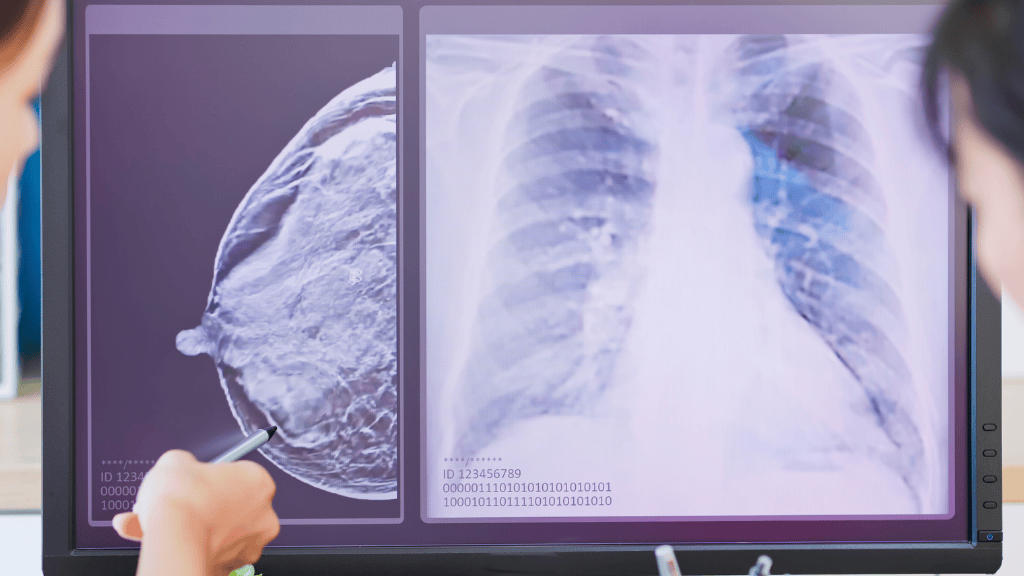
Breast cancer remains the most commonly diagnosed cancer among women worldwide. Early detection through regular mammography screening is one of the most effective strategies to reduce mortality. Now, large-scale clinical evidence confirms that artificial intelligence (AI) can significantly enhance this process.
A recent clinical trial published in The Lancet, involving more than 100,000 women has shown that AI-supported mammography improves early breast cancer detection rates while maintaining safety standards and reducing radiologist workload. These findings mark a turning point in how screening programs may be structured in the coming years.
For international patients seeking advanced cancer screening in Europe, this represents a critical evolution in diagnostic precision and patient safety.
What Did the 100,000-Woman MASAI Trial Reveal?
The MASAI trial, a large, prospective, randomised clinical study conducted in a real-world population screening programme, included more than 100,000 women and compared AI-supported mammography with traditional double reading by two independent radiologists.
Unlike earlier technical validation studies, this trial provides high-level clinical evidence. According to expert commentary published by the Science Media Centre Spain, its strength lies in evaluating clinically meaningful outcomes rather than purely technical performance metrics.
From a breast radiology perspective, the study assessed whether integrating artificial intelligence into screening programs could:
- Improve cancer detection rates
- Reduce interval cancers
- Detect tumours at earlier and biologically more favourable stages
- Maintain low false-positive rates
- Reduce radiologist workload
The results were particularly significant:
- 12% reduction in interval cancers, one of the major limitations of conventional screening due to their typically more aggressive behaviour and poorer prognosis
- Decrease in invasive, larger, and biologically aggressive tumour subtypes
- False-positive rates maintained at approximately 1.5%, avoiding unnecessary recalls and patient anxiety
- 44% reduction in radiologist reading workload
As explained by Ignacio Miranda Gómez, Head of the Breast Imaging Unit at the International Breast Cancer Center IBCC and Teknon Medical Center, the trial goes beyond simply detecting more cancers. It demonstrates that AI contributes to identifying tumours earlier and with more favourable biological characteristics, likely due to improved detection of subtle lesions that can be difficult to interpret with the human eye alone.
Importantly, AI was not used as a replacement for radiologists. Instead, it was integrated into the workflow as:
- A triage tool for low-risk cases
- A focused double-reading support system for high-risk cases
- A structured decision-support instrument
This organisational model suggests not substitution, but optimisation — redefining how screening programmes can operate more efficiently while maintaining safety and quality standards.
Why Early Detection Changes Outcomes
The clinical impact of earlier detection cannot be overstated. When breast cancer is diagnosed at Stage I rather than Stage III or IV:
- Treatment is often less aggressive
- Surgical procedures may be more conservative
- Chemotherapy may be avoided in some cases
- Long-term survival rates increase significantly
- Quality of life outcomes improve
AI-enhanced screening programs aim to shift diagnoses toward earlier, more treatable stages, improving both clinical and emotional outcomes for patients. For women considering breast cancer screening in Spain, the integration of AI into mammography protocols may represent an additional layer of diagnostic reassurance.
Breast Cancer Screening in Spain: Advanced Technology and International Care
Spain has become an increasingly important destination for international oncology care, combining high clinical standards with advanced medical technology. At Barcelona International Hospitals, member hospitals integrate:
- Advanced digital mammography systems
- Multidisciplinary breast units
- Comprehensive oncology teams
- Personalized diagnostic pathways
- International patient support services
The adoption of innovative technologies such as AI-supported mammography aligns with a broader commitment to precision medicine and early detection. For patients traveling to Barcelona for breast cancer screening or second opinions, access to advanced imaging tools is an important component of care quality.
What This Means for International Patients
Patients researching:
- “Breast cancer screening in Spain”
- “AI mammography Europe”
- “Early breast cancer detection Barcelona”
- “Private breast imaging center Spain”
- “Advanced cancer diagnostics in Spain”
are increasingly looking for institutions that combine expertise with technological leadership.
AI-supported screening reflects a shift toward:
- More accurate diagnostics
- Reduced diagnostic delays
- Data-driven clinical decisions
- Enhanced patient confidence
For international patients, especially those from countries with longer waiting times, accessing advanced screening protocols abroad can provide both speed and precision.
The Future of Breast Cancer Screening Is Augmented, Not Automated
Artificial intelligence represents one of the most significant advancements in preventive oncology in recent years. The combination of:
- Expert radiologists
- Advanced imaging infrastructure
- AI-assisted analysis
- Multidisciplinary oncology teams
creates a more robust, accurate, and patient-centered screening model.
As clinical evidence continues to grow, AI-supported mammography is likely to become a standard component of organized breast cancer screening programs worldwide. For patients considering advanced breast cancer screening in Spain, choosing institutions that integrate innovation with clinical expertise may offer measurable advantages in early detection and diagnostic confidence.
Frequently Asked Questions About Cancer Screaning
Large clinical trials show that AI-supported screening improves cancer detection rates while maintaining safety standards.
No significant increase in false positives was observed in large population studies.
Yes. AI is used as a support system under radiologist supervision and has been validated in large-scale trials.
Leading private hospitals in Spain are integrating advanced imaging technologies, including AI-supported diagnostics, particularly in major cities such as Barcelona.
No. The radiologist remains responsible for the final diagnosis. AI enhances decision-making but does not replace clinical judgment.
To learn more about the advantages of Barcelona International Hospitals and schedule a consultation, please fill out the contact form on our website.